When AI organizes from tens to hundreds of thousands
From a fifty-person team to a two-hundred-thousand-strong enterprise, OpenKnock Culture Ladder organizes responses at every scale with the same honesty. Measurement criteria are crafted by professional safety consultants; an AI workflow we built sits in exactly one place, turning hundreds of billions of response data points back into something a person can read.

OpenKnock Culture Ladder's diagnostic has to land at the same level for a company of fifty as for an enterprise of two hundred thousand. But no single person can read hundreds of thousands of responses one by one. AI sits in exactly the place that folds those responses into something a human can read again — and the moment that AI takes a single step outside its territory, every meaning it folded together comes apart.
Whether AI ties a response to the exact place in the company, or scatters it into generalities that could fit anywhere — the answer splits in one place. Whether the AI speaks inside its own territory of safety-culture measurement, or outside of it. We call this territory the AI must stay inside the domain.
Speak inside the domain, and a single line of response lands precisely on which Theme · which step in the company. Take one step outside, and the same line scatters into communication among members is insufficient, a workshop is needed— phrases that could be pasted onto any company on earth. All of AI's value in a safety-culture diagnostic comes from one promise: the AI's mouth opens only inside the domain.
01 · Not a replacement
AI does not replace people
AI does not replace the person reading. It only makes a quantity that couldn't be read, readable.
The foundation of the program came out of human hands. The professional safety consultants who build OpenKnock together with us hand-built the program — from the measurement design algorithms down to the threshold-value data for each of the five steps — and the program stands on top of that work. AI does not set the measurement standard, nor does it interpret what the measurement means. That place is a human place.
So where is the AI pinned? In the hundreds of billions of response data points that a single survey of hundreds of thousands of respondents produces.A quantity that previously couldn't be analyzed, or could only be barely grasped at enormous labor cost. Exactly there — in the place that folds that quantity into something a person can really read — the collection of AI agents we built, the workflow, starts its work. The singularity of this program sits precisely in this place.
Read this line again from the program's point of view, and the AI's job is not interpretation but reduction; the human's job is to take that reduction and judge again. Whether the company has 50 or 50,000 people, however much the responses grow, in the end they have to be folded into a single-digit number of themes a person can read. How to judge those ten or so is still on the human.
02 · Multi-dimensional analysis
The same response shows up in many places at once
OpenKnock Culture Ladder's analysis does not end in one place. A single survey is analyzed simultaneously across many places where several criteria and several angles intersect.
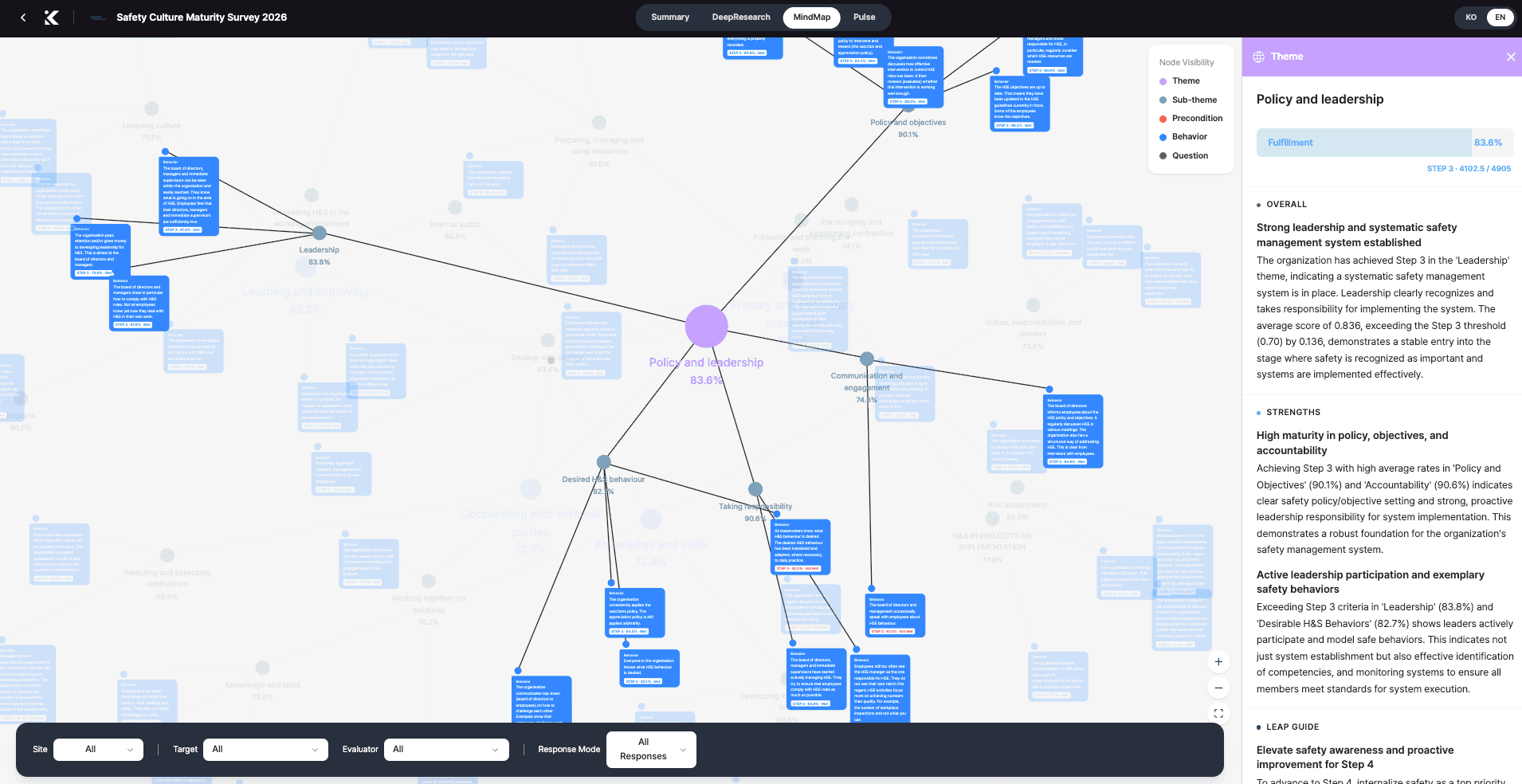
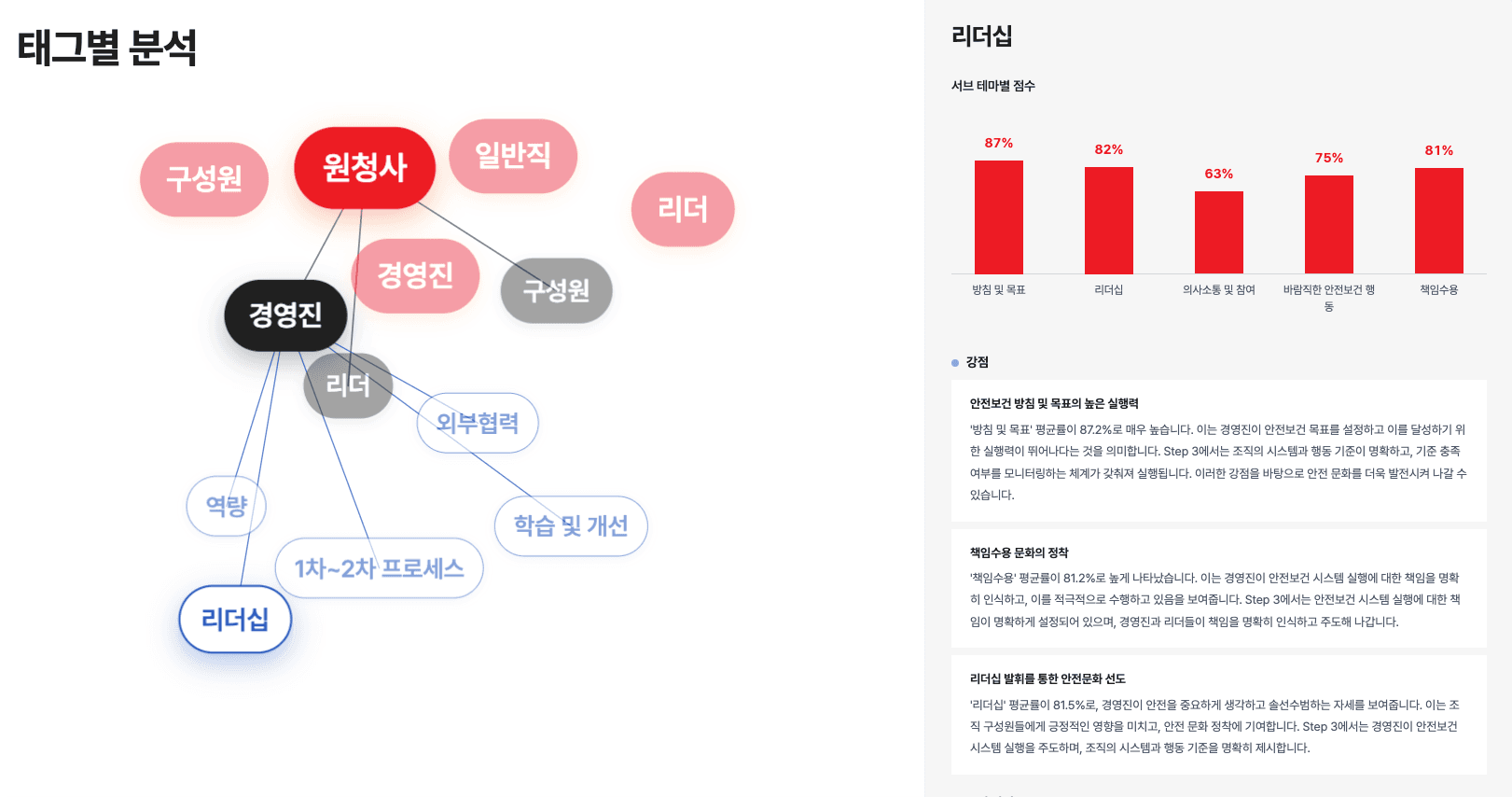
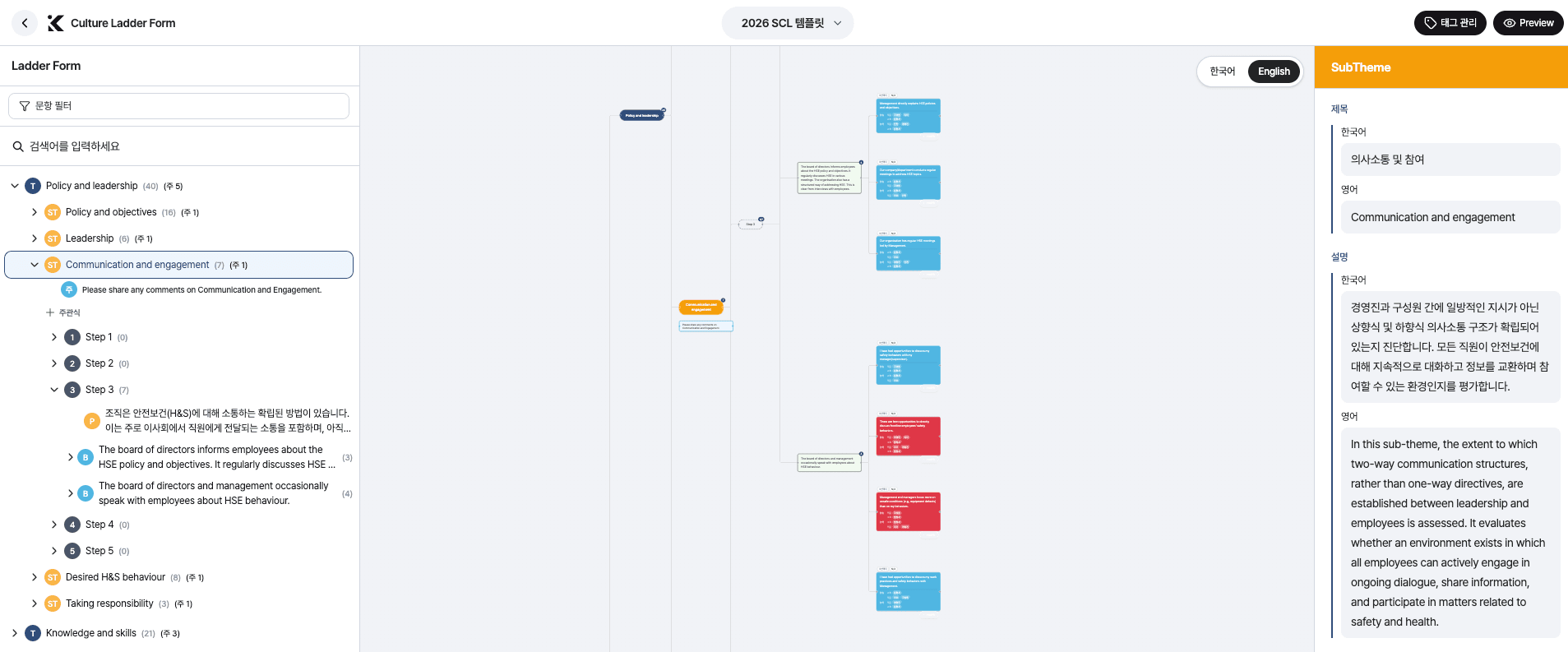
First it splits along three criteria. The largest category, Theme (“information flow,” “learning,” “leadership”); the sub-region inside it, SubTheme(“risk reporting” under “information flow”); and the smallest measurable line of behavior, Behavior(“reports a hazard upward when spotted”). The same response gets analyzed separately, once at each of the three criterion places.
And it splits along three angles as well. By site (which factory, which division's landscape), by respondent (who answered — executive, leader, worker), and by analysis target (who the response is about — executives, leaders, peers, oneself). Because the same criterion place looks different depending on who, from where, evaluating whom.
Three criteria × three angles intersect, and on the dashboard a single survey unfolds into hundreds of places of analysis. The landscape visible at “A-plant × answered by worker × evaluating executives” and the landscape at “B-plant × answered by executive × evaluating themselves” become different pictures — even though they start from the same one-line response.
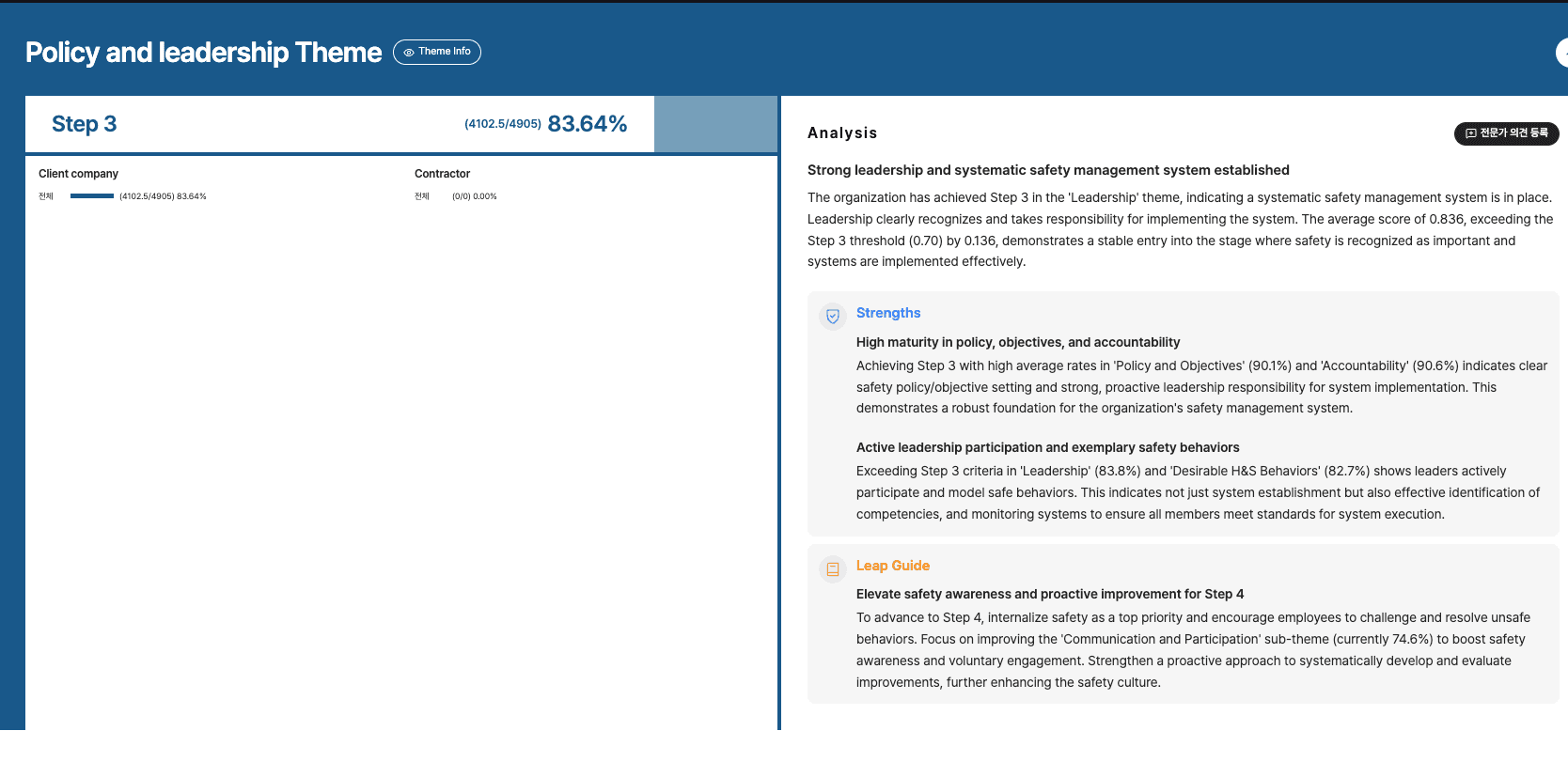
All of these places — possibly numbering in the hundreds — OpenKnock's sLLMreceives one place at a time and runs the same analysis on each. First the step score for that place is captured, and against the target step the company set, it's ruled cleared / missed. On top of that follows a single paragraph summarizing the place, plus strengths and weaknesses; and finally, for missed places, improvement points showing where to start working; for cleared places, a jump guide showing how to leap to the next step.
Looking at one diagnostic in hundreds of places at once. That is the depth of OpenKnock Culture Ladder's analysis.
03 · Inside the domain
Open the AI's mouth only inside the domain
For the promise that AI organizes the responses of hundreds of thousands to carry weight, the promise that the AI doesn't take a single step outside its domain has to be pinned in alongside it. We couldn't keep that promise by handing everything to a single model.
So we combined two models inside a single workflow. In the place that receives the vocabulary and grain of the safety and organizational-culture domain, we put a domain-specialized model (sLLM) we trained ourselves; on top of that, general language interpretation, the nuance the respondent intended, relationships between sentences, multilingual processing across Korean / English / Japanese — we left those to a verified general-purpose LLM API. By composing the two grains inside one flow, we optimized the workflow so the model's mouth opens only inside the domain.
For example, when a respondent writes “communication is poor,” using only the general API gives back a generic keyword like “communication absence.” The same line, run once through our sLLM, gets precisely mapped to the SubTheme of “information flow / risk reporting.” Where the response lands in the company splits completely depending on how these two models are combined.
The place where AI becomes able to organize hundreds of thousands of responses is also the place where AI becomes able to flatten all of them into nothing.
The next part is the last of the series. The place where the weaknesses and improvements the AI laid out don't disappear into a PDF folder, but cross into the Action module and connect into the re-measurement of the next survey — the closed loop from measurement to change.
Written by

Yunhwan Jeong
Founder
Runs schemalism. Develops the business from an engineer's vantage — enjoys taking a hypothesis, validating it firsthand, and pushing it into the next bigger stage. Picks the next move every time at the seam where code meets business.
Part of this series
Can organizational culture actually be measured?
OpenKnock Culture Ladder is a survey-based diagnostic for organizational safety culture. The benchmark isn't ours. We lifted NEN SCL, the Dutch national safety-culture certification standard, and use its five-step ladder as is, asking which of the five rungs a company stands on, round after round, against the same benchmark. Built by schemalism with RIMS and LRQA, and already pinned in place on the same benchmark by Hyundai Mobis, Kumho Petrochemical, and POSCO International, ~15,000 responses in. Six essays on what we saw between measurement and change.
All parts
06

PART 01
Atmosphere isn't culture
PART 02
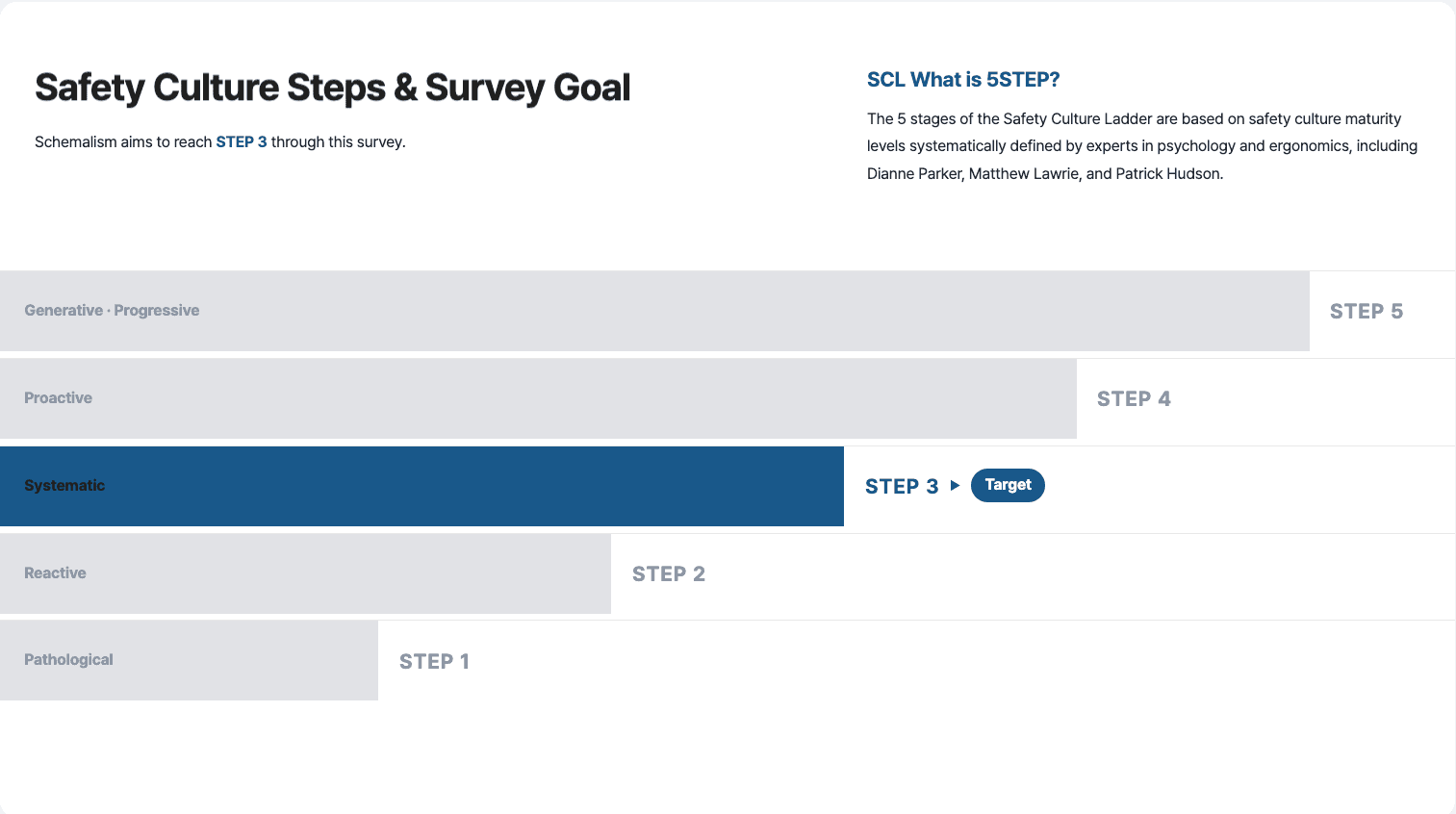
Five rungs from the standard
PART 03
The core
PART 04
Rounds and benchmark
- You are here
PART 05
AI inside the domain
PART 06
From measurement to change